
Former chancellor Rishi Sunak convincingly won over an audience of Conservative Party members in a head-to-head television debate with rival Foreign Secretary Liz Truss in the leadership contest to elect a new Tory party leader and British prime minister.

Vehicles are depreciating assets and lose their value over time.

If they can sit together and hammer out 'Black Sea Initiative' deal for much needed food shipments, surely, they should be able to address the madness of the larger military conflict?

Gaurav Garg, head of research at CapitalVia Global Research Limited will answer your stock market queries.

Retail inflation slowed to 4.29 per cent in April from 5.52 per cent in March, mainly due to easing food prices, government data showed on Wednesday. The Reserve Bank mainly factors in the retail inflation based on Consumer Price Index (CPI) while arriving at its monetary policy. As per the data released by Ministry of Statistics and Programme Implementation, inflation in the food basket was 2.02 per cent in April, down from 4.87 per cent in the preceding month.

Finance Minister Nirmala Sitharaman has said the recent interest rate hike by the Reserve Bank was not surprising for her but the timing was, asserting that the rising cost of funds will not impact the government's planned infrastructure investments. For the first time since August 2018, RBI had on May 4 delivered a blunt 40 basis points increase in key repo rate to 4.40 per cent, and also hiked the cash reserve ratio by 50 basis points to 4.5 per cent after an unscheduled meeting of the rate setting panel, citing increased inflation pressures following the Ukraine war and the resultant spike in crude oil prices. Retail inflation printed at 6.9 per cent in March and the April reading is forecast to top 7.7 per cent.

Investors widened their bets on optimism that upcoming general budget -- to be unveiled next month - would contain incentives for corporates, which will help boost the economy

India is the most polluted country in the world, with more than 480 million people or about 40 per cent of its population living in the Indo-Gangetic plains in the north where pollution levels regularly exceed those found anywhere else in the world by an order of magnitude, stated the University of Chicago's Air Quality Life Index (AQLI) report.

The rise was due to a sharp fall in prices, which spurred demand.

A statement issued by the Prime Minister's Office on Monday said that Mahinda Rajapaksa intends to propose a new Constitutional Amendment to the cabinet in order to fulfil the people's aspirations.

Tata Motors group's investment for this fiscal is pegged at Rs 28,900 crore, mostly for its British arm Jaguar Land Rover (JLR), company chairman N Chandrasekaran said on Friday. The company will also look to raise capital separately for its electric vehicles (EV) business at an appropriate time. It is looking to have 25 per cent of its sales coming from EVs in the medium to long term, up from 2 per cent at present, he said while addressing the company's virtual AGM.

Inflation in food articles during June stood at 2.04 per cent, as against 1.13 per cent in May.

Calling Prime Minister Narendra Modi "Saheb" during a discussion on the government's resolution on good works in the Delhi assembly's special session, Kejriwal said the nation is not with him in his "theatrics".

He said the ministry was looking forward to suggestions from the state governments and discussions were underway with all the stakeholders to arrive at a policy which would bring back growth in the aviation sector.

'An earthquake of a slightly higher magnitude in the Western Himalayan region is going to be catastrophic -- not just because of the fragility of the region but because of how densely we have occupied it.'

The overwhelming feeling at the end of COP 27 was that despite decades of meetings and landmark accords, like the Paris Agreement, the world was still not doing enough to slow the climate crisis, observes Ambassador T P Sreenivasan.

The rise in US bond yields spooked investors last week and there could a further increase given the inflation dynamics, according to Christopher Wood, global head of equity strategy at Jefferies. "The US bond market sell-off has continued over the past week, and with it the increased potential for an inflation scare. "Still, there is plenty of scope for bonds to sell off more since the last time the 5-year forward inflation expectation rate was running at current levels (namely in early December 2018), the 10- and 30-year bond yields were significantly higher at 2.91 per cent and 3.17 per cent, respectively," the market guru said in his newsletter GREED & fear. The 10-year and 30-year US Treasury finished at 1.34 per cent and 2.13 per cent, respectively, last week.

India on Monday joined a US-led initiative to set up an Indo-Pacific Economic Framework to bind partner countries to achieve common goals, with Prime Minister Narendra Modi asserting that New Delhi will work with the stakeholders to make it an "inclusive and flexible" structure to pave the way for development, peace and prosperity in the region.

Costlier vegetables and eggs pushed up retail inflation to a nearly six-and-a-half year high of 7.61 per cent in October, keeping it significantly above the comfort zone of the Reserve Bank.

Discover some of the winners of 2022 World Press Photo Contest.

Business failures rise when growth declines. When Indian growth slowed in the last decade, defaults increased. This is the normal working of the market economy, points out Ajay Shah.

Finance Minister Nirmala Sitharaman presents her fourth Budget in Lok Sabha on Tuesday.

If you are serious about countering the Chinese threat, then the best weapon is investing in real freedom, plurality, elections and democracy. Unfortunately, it isn't an approach all Indians currently seem to agree on, asserts Shyam G Menon.

RBI targets to keep inflation at 4 per cent, (+/- 2 per cent), and its rise beyond this comfort zone will put pressure on the central bank to hike rates.

Besides low interest rates, a reduction in active Covid cases and strong high-frequency macro data have lifted the sentiment of both corporate India and the stock markets.

Although there is headroom for further monetary policy action, at this juncture it is important to keep our arsenal dry and use it judiciously: RBI's Das.

India's factory output climbed 22.4 per cent in March, benefiting from the base effect of the lockdown-marred month a year back as well as a turnaround in the manufacturing sector, while retail inflation slipped to a three-month low of 4.29 per cent in April. The high positive annual growth in the index of industrial production (IIP) in March 2021 came on back of a contraction of (-)0.9 per cent and (-)3.4 per cent in January and February 2021 respectively, according to the data released by the National Statistical Office (NSO) on Wednesday. This turnaround was led by recovery in the mining, manufacturing and electricity sectors.

With the first quarter gross tax mop-up reaching Rs 5.6 lakh crore, Icra Ratings on Friday said the government is set to exceed the budgeted tax collection target of Rs 22.2 lakh crore for 2021-22, led by indirect taxes. The government has budgeted a modest 9.5 per cent growth in tax collections at Rs 22.2 lakh crore for FY22, over FY21 collections of Rs 20.2 lakh crore. However, despite the second wave of the pandemic, the April-June quarter tax collections rose to Rs 5.6 lakh crore, which is 39 per cent higher than Q1 of FY20.
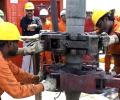
The pricing and marketing freedom for exploitation would be capped by a ceiling price.


The wholesale price-based inflation rose to an eight-month high of 1.48 per cent in October, as manufactured products turned costlier. The WPI inflation was 1.32 per cent in September and zero per cent in October last year. This is the highest level of wholesale price index-based (WPI) inflation since February when it was 2.26 per cent.

COVID-19 forced people to work from home turned into the fuel for new demat accounts, observes Debashis Basu.
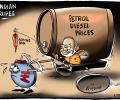
Retail inflation inches up to 3.77%; IIP growth dips to 3-month low
The minister expressed confidence that India will get back to high growth path soon.

The Reserve Bank had kept policy rate unchanged in its review on April 7.
Retail inflation remained above the RBI's comfort level for the second consecutive month despite slipping slightly to 6.26 per cent in June while the factory output recorded a growth of 29.3 per cent in May, mainly on account of the base effect, the government data showed. The marginal slippage in the Consumer Price Index (CPI)-based inflation was noticed despite little firmness witnessed in the food inflation which inched up to 5.15 per cent in June from 5.01 per cent a month ago. Retail inflation based on Consumer Price Index (CPI) was 6.3 per cent in May 2021 and 6.23 per cent in June 2020.

Life insurers, on the prodding of global reinsurers, are set to hike premiums on term plans because rising mortality after the second wave of the pandemic has led to an increase in the number of settlements. Some will do so next month while others may wait till January. Global reinsurer Munich Re had nudged its insurance partners on the hike in September and insurers have been engaged in negotiations with the reinsurer on the amount of the increase. Term plan prices in India were among the lowest in the world for a long period but in the past couple of years, they have been increased a few times.

Prime Minister Narendra Modi was not present at the all-party meeting convened by the government.

India's economic growth is estimated to have slowed down to 11-year low of 5 per cent during the current financial year ending March 2020.

The President said he made the decision in consultation with European allies but added they may not be in a position to join the US in banning Russian energy imports.
